NoiseFloor.
The output without an author.
Text, music and online engagement generated by AI now arrive at scale. Output volume is not the same as verified human attention, and the systems that receive it cannot always tell who or what sent it. This issue looks at how much of it there is, the marks meant to identify it, the rules that require those marks, who ends up checking it, and what it does to learning.
Key findings
Five findings.
- Scale. Pew Research Center sampled 10,000 English-language web pages in July 2026. One in ten showed significant signs of AI authorship. Among pages dated after November 2022, which are a non-random minority of the archive, the share was over a third. On .com addresses, Pew's six-month averages rose from about 1% to 9.35%.1
- Measurement. A validated method can help estimate how much of a large body of text is AI-written. Whether one person cheated is a different question, and it needs different evidence. A court ruling, several universities' decisions and a major conference's procedures each reflect this in different ways; they do not add up to a single rule.2,3,4,5,6,7,8
- Marking. A detected watermark or signed record can be evidence that content was generated or processed by a tool covered by that scheme. What it covers, who can check it and how well it survives editing all vary. Published tests show that editing weakens marks in text.9,10
- Volume. arXiv, the preprint server widely used in physics, mathematics and computer science, received about twice as many submissions in September 2026 as in September 2024. It now limits each submitter to two new submissions a month.11
- Learning. In two controlled studies, students using AI scored better on the assisted tasks. Neither study showed a matching advantage on the outcomes assessed without AI. In the mathematics study, students with unrestricted access did worse on the exam taken without it. For a tutor designed to give hints rather than answers, the authors report that this loss was largely mitigated. The outcomes and interventions differed.12,13,14
Chapter 01 · The floor rises
More output. Uneven attention.
Deezer reported in July 2026 that fully AI-generated tracks made up more than half of its daily uploads, about 90,000 a day at the June peak.15 By its own count, those tracks drew between 1% and 3% of streams, and in 2025 it classified up to 85% of their streams as fraudulent.15 Uploads and streams are different measures, so they do not give a listening rate. They do show the distinction this issue follows: output volume is not the same as verified human attention.
Pew Research Center scored about 490,000 English-language pages from the Common Crawl web archive, collected between 2021 and 2026.1 Four domains started at similar levels and then diverged, with .com rising fastest. Pew notes that its detector also flags pages that were substantially edited with AI, that it misclassifies some individual pages in both directions, and that it reports a higher false-positive rate on older pages. A higher error rate on older pages lifts the starting point; it does not by itself create the later rise.1
Science shows the pressure in its own terms. arXiv received 9,869 submissions in September 2016, 20,569 in September 2024 and 40,363 in September 2026. The chair of its editorial advisory council says a relatively small proportion of authors takes up a disproportionate share of moderators' time.11
News is measured differently. NewsGuard's tracker, in an update dated 23 June 2026, listed 3,749 websites it classifies as AI content farms, in 16 languages including Arabic. That is NewsGuard's own inventory of sites it has identified, not a census of news sites, and a single count rather than a trend.23
Swipe inside a figure to view more →
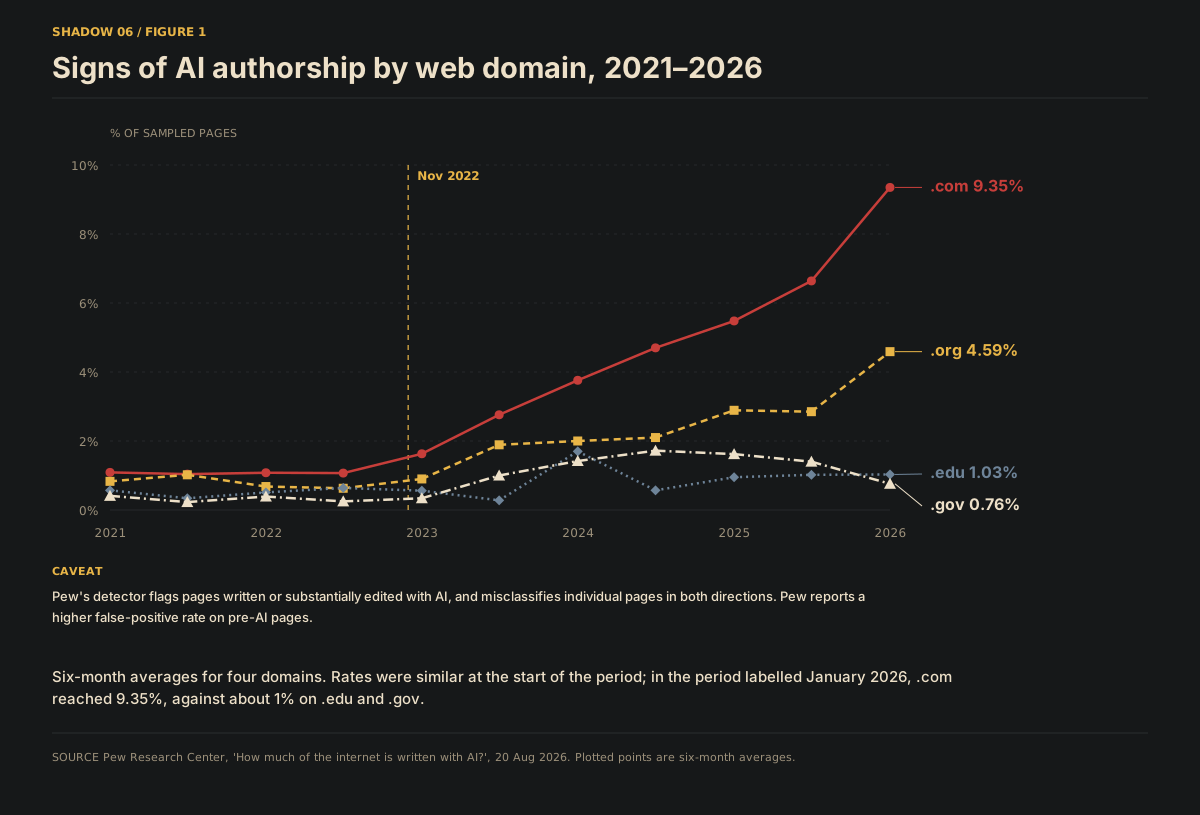
Each line is one web domain. Each point is a six-month average of the share of sampled pages that Pew's detector flagged. The lines show reported classification rates in different domain samples. Domain-specific error rates were not established; differences should not be treated as error-free estimates. The marker shows November 2022.
Sources: 1
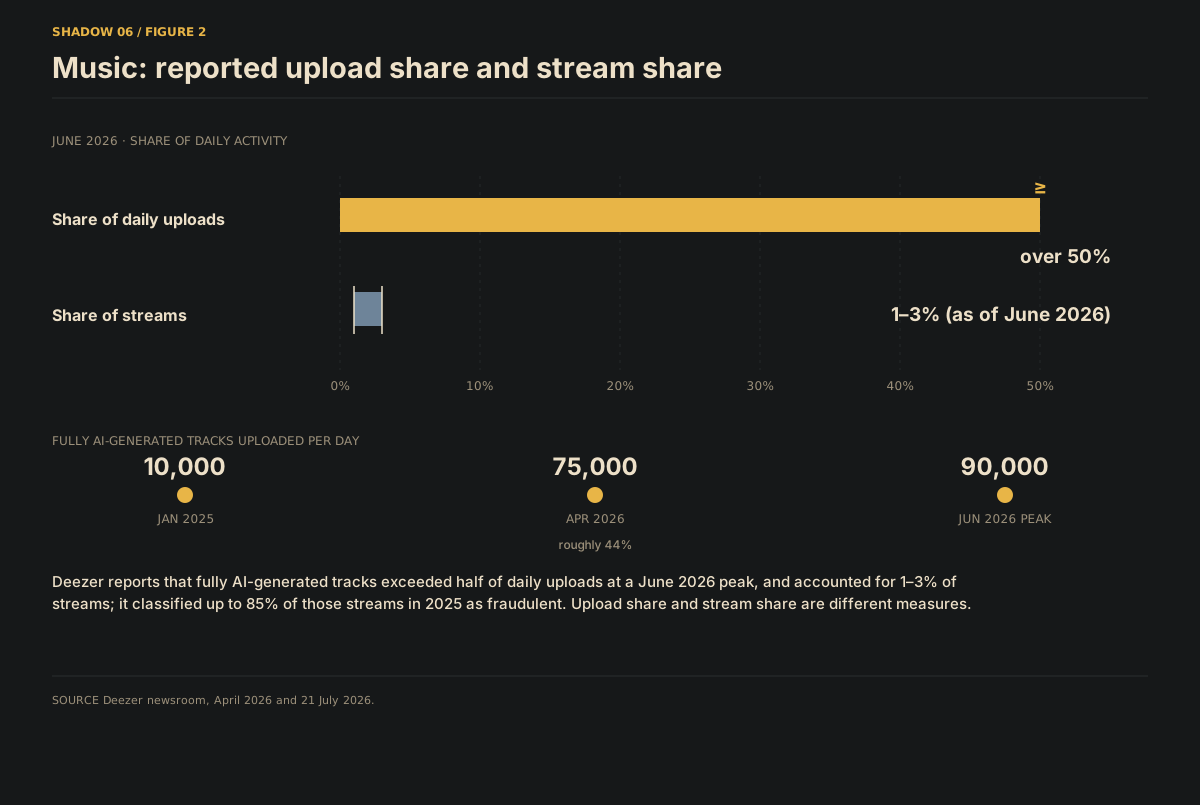
The upper bars compare two different measures for June 2026: the share of daily uploads and the share of streams. They do not track the same set of tracks over the same period, and streams are not a measure of verified human listening. The lower row shows how many fully AI-generated tracks Deezer reported receiving per day at three dates.
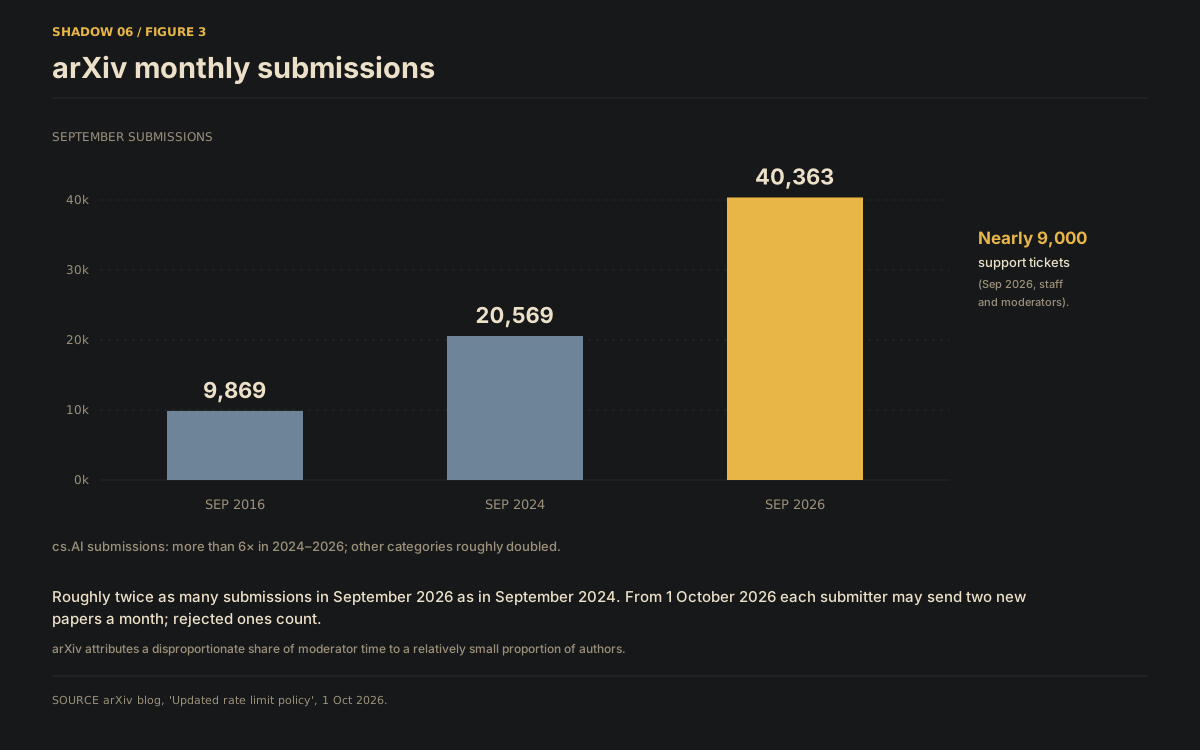
Each bar counts the submissions arXiv received in one September. The 2026 bar is roughly double the 2024 bar. The new limit applies to each submitter, and rejected submissions count towards it.
Sources: 11
Chapter 02 · Who wrote this?
Counting is not judging.
In January 2026 a New York court annulled a university's finding that a student had broken academic-integrity rules. The professor had reported a 100% score from one AI detector; two other detectors, run on the student's behalf, gave 0%.6 The court ruled on the record of this case:
- the university had not considered the contrary evidence;
- the professor later wrote that he had expected the integrity office to assess the file independently;
- the student had been denied an adviser of his choice;
- the officer who made the decision also decided the appeal.
The court made no general finding on whether detectors work.6
"How much of this collection was written with AI?" is a question about a population. "Did this student write this essay?" is a question about one person. A method validated on a population can help with the first.8 A score for one document is a single piece of evidence, and its weight depends on how the detector was calibrated and on what is being decided. Turnitin's own guidance says its result should not be the sole basis for adverse action against a student.2 The universities of Waterloo, Curtin and the Free State have switched off its AI detection.3,4,5
At NeurIPS 2026, a machine-learning conference, the chairs of the position-paper track screened submissions with a commercial detector and set different decision routes for different score bands. They desk-rejected 178 submissions in the highest-scoring group, and offered the authors of 123 more, in a lower band, a chance to submit version history as evidence. The post does not list additional considerations for every group. The chairs explained that submitting AI-generated text for review shifts the cost of verifying it onto reviewers.7
In late January 2026 the security firm Wiz found an access-control exposure in the database of a social network built for AI agents. The platform fixed it with Wiz's help, and Wiz published its findings on 2 February 2026. In the database as it stood before the first fix on 31 January, Wiz counted about 1.5 million registered agents and about 17,000 human owners, and reported that the platform had no way to check whether an "agent" was an AI system or a person running a script.37 A separate study recorded 6,159 accounts that posted or commented in an early observation window.39 Registrations are not evidence of activity, and neither count shows how many accounts ran autonomously.
Swipe inside a figure to view more →
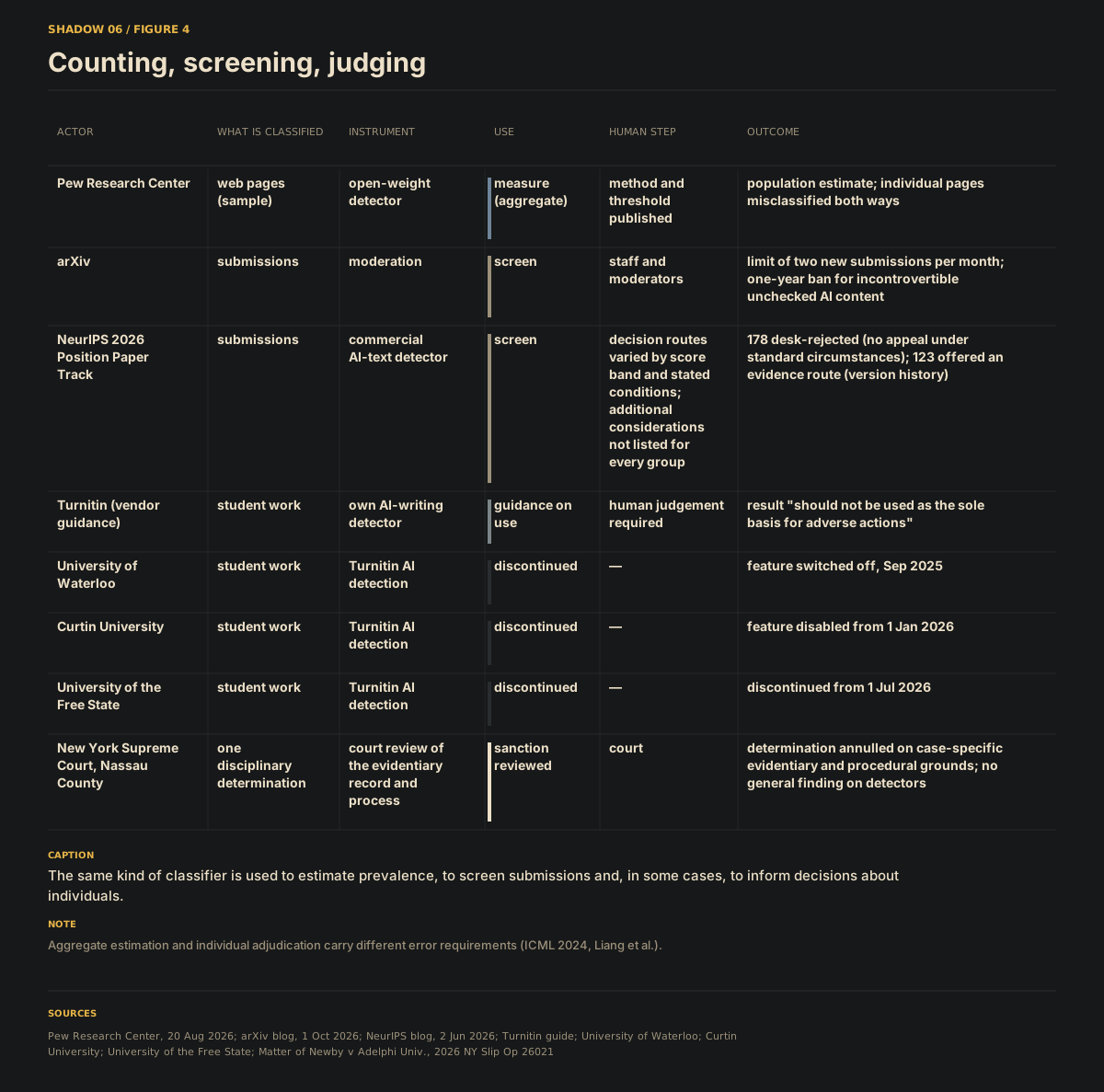
Each row is one actor and what it did with a classifier or with classifier evidence: measuring a population, screening submissions, issuing guidance, switching a feature off, or, in the court's case, reviewing the evidence and procedure behind one decision. The "Use" column gives the purpose; the "Human step" column shows where a person or body takes part.
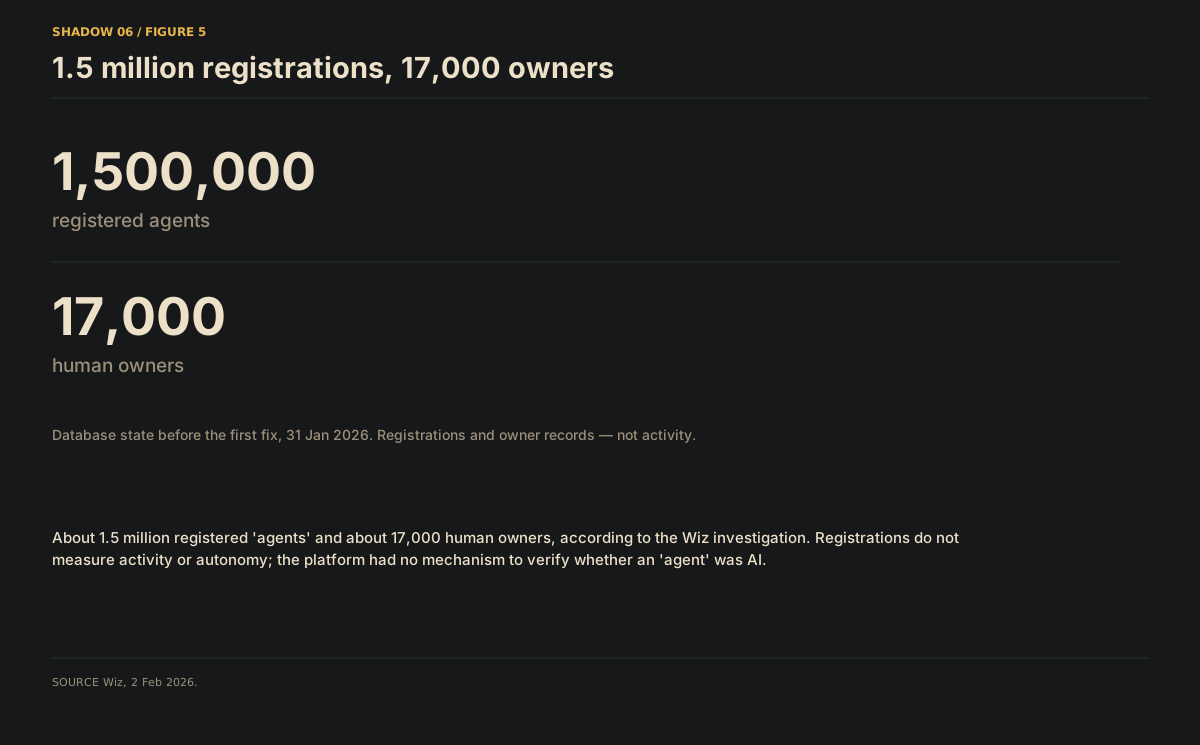
Both numbers come from the same database, as it stood before the security flaw was fixed on 31 January 2026. They count registrations and owner records. Neither shows the total active population, or how many accounts were run by AI. A separate study recorded 6,159 posting or commenting accounts in its own early window.
Chapter 03 · Marks that fade
A mark answers a limited question.
A provenance check looks for evidence from one particular watermark or signed record. A match can be evidence that the content was generated or processed by a tool covered by that scheme. It does not prove who wrote the content or whether it is true. No match does not prove that a person made it.9,10,40
Signed records, known as C2PA Content Credentials, can be stripped when a file is uploaded, converted, resized or captured as a screenshot.41 Stripping that metadata does not by itself remove a watermark embedded in the content, and a compatible watermark can help recover lost records.42 How well an embedded mark survives other transformations depends on the scheme. Researchers have removed image watermarks by purification and by "visual paraphrase".43,44 For text, published tests show that marks weaken as the text is edited or paraphrased.9,10
Who can run a check varies widely, from public websites to programmes open only to approved researchers. Figure F6 sets out what three providers have published, using the same questions for each.
Swipe inside a figure to view more →
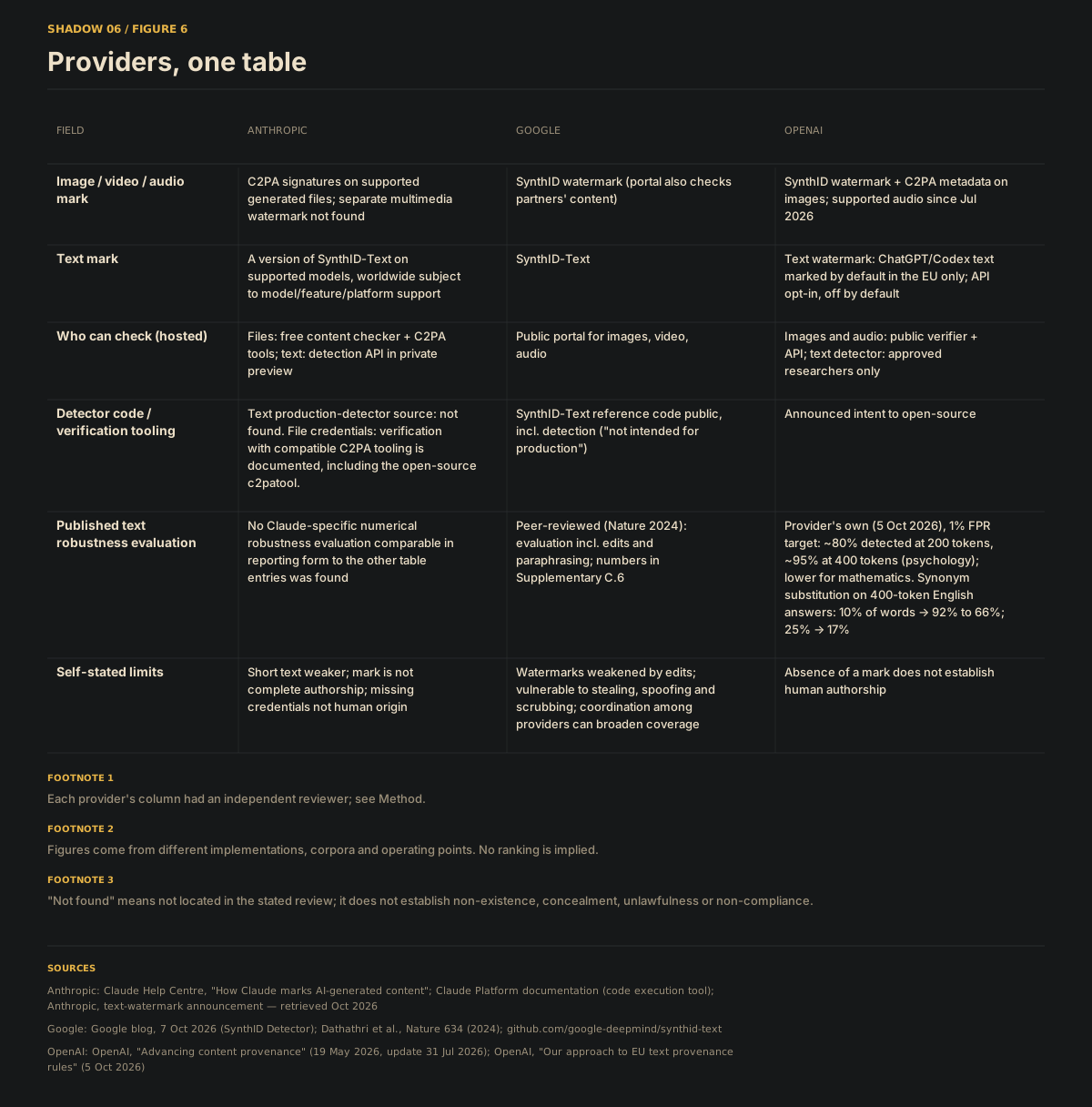
Each column is one provider, and each row asks all three the same question. The cells summarise what the provider or its researchers have published. The test results in the robustness row come from different methods and data, so they cannot be compared across columns. The table does not rank the providers.
Sources: 9, 10, 40, 41 (and the provider sources listed under the table)
Chapter 04 · Who must mark what
Marking duties. Different forms.
Two transparency regimes took effect on the same day, 2 August 2026:
- European Union. Article 50 of the AI Act requires providers to mark AI-generated output in a machine-readable form, with some exceptions. It requires deployers to disclose deepfakes. It also requires them to disclose AI-generated text published to inform the public on matters of public interest, unless the text has undergone human review or editorial control and a person holds editorial responsibility for it. That exception applies only to the text disclosure.49
- California. The AI Transparency Act requires latent disclosures in AI-generated images, video and audio. Its user threshold was removed in September 2026.50,53
Elsewhere the forms vary: statutes in India, South Korea and Vietnam, an election rule in Singapore, and voluntary guidance in Australia, Malaysia and Ukraine.55,56,64,65,48,67,69
We reviewed five Gulf states: the UAE, Saudi Arabia, Qatar, Bahrain and Oman. This is not an exhaustive statement of their AI-content obligations. The measures we identified work through media regulation, content standards and published AI policies:
- In the UAE, WAM reported on 25 September 2025 that the UAE Media Council had stated that using AI to depict national symbols or public figures without prior official approval violates media content standards, and that misuse of AI to spread misinformation, incite hatred or defame others is subject to the media violations regulation.59 The Council is named as the issuer of that statement; the National Media Authority, established under Federal Decree-Law No. 11 of 2025, has since replaced it.103 Khaleej Times and Gulf News reported at the end of September 2026 that the Authority had restated this prior-approval requirement in a post on its official account; we did not retrieve the post itself.104
- WAM reported in August 2026 that the International Centre for Combating Media Disinformation had announced an AI-supported system for monitoring and verifying digital content, now in development, and an international charter on media integrity.60
- Qatar, Bahrain and Oman have published AI policies or guidelines.61,62,63
- Saudi Arabia's published guidance was located but could not be verified in enough detail to describe.57
Swipe inside a figure to view more →
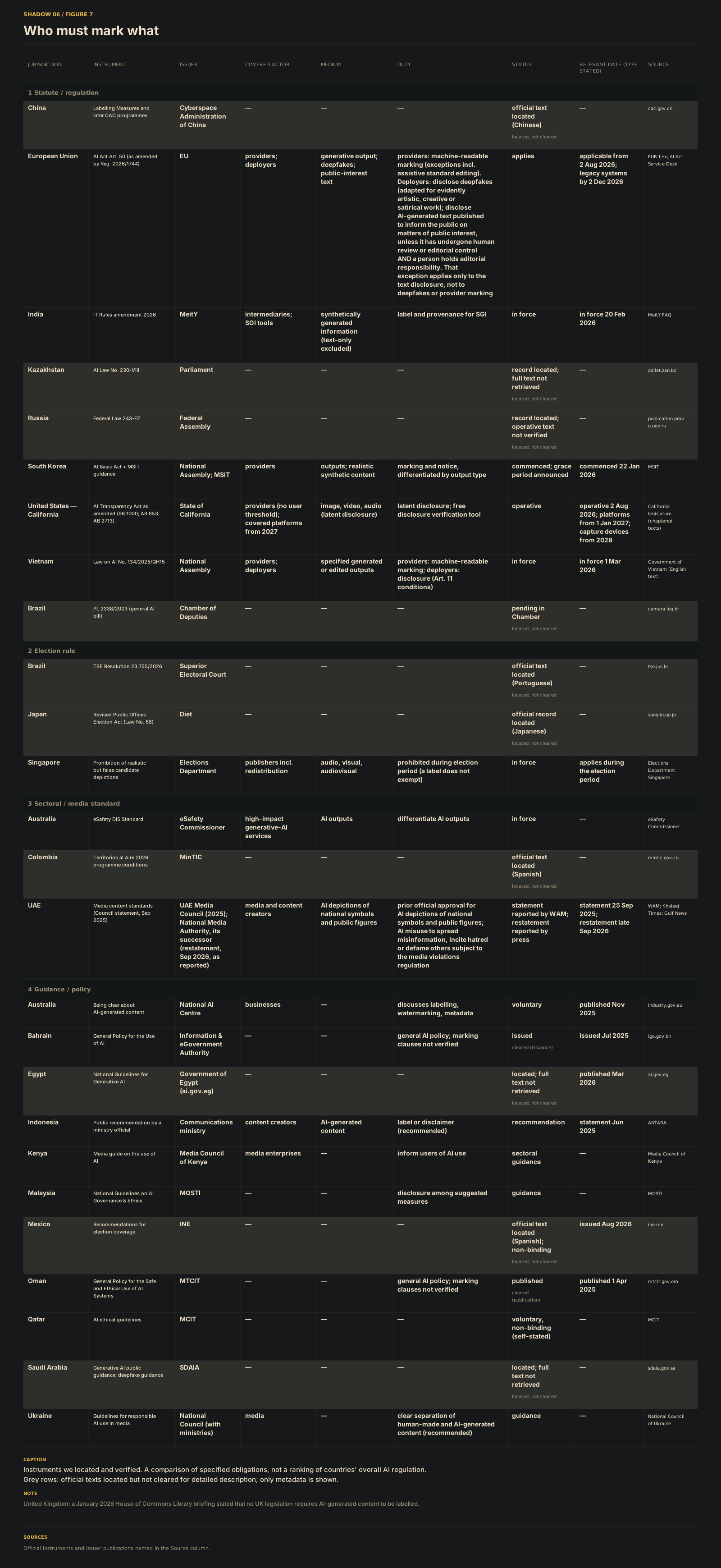
Rows are grouped by type of instrument: statutes and regulations, election rules, sector standards, and guidance or policy. Read along a row to see who must do what, for which kind of content, and from when. The date column states what kind of date it is: application, entry into force, publication or issuance. Grey rows are official texts we located but could not verify in enough detail to describe; only their metadata is shown. The table compares specified obligations; it does not rank countries.
Sources: 46, 48, 49, 50, 53, 54, 55, 56, 57, 58, 59, 103, 104, 61, 62, 63, 64, 65, 66, 67, 68, 69
Sources: 46, 48, 49, 50, 53, 54, 55, 56, 57, 59, 60, 61, 62, 63, 64, 65, 67, 69, 103, 104.
Chapter 05 · Who checks the volume
The checking load, in science.
When submitters do not check their work, the people who receive it can end up doing so. The clearest documented case is science:
- Moderators. arXiv reported that September 2026 submissions generated nearly 9,000 support tickets for its staff and moderators.11 The chair of its editorial advisory council has said that authors who submit incontrovertible, unchecked AI-generated content face a one-year ban. Using AI is allowed.72
- Reviewers. They are on both sides. They receive AI-assisted papers, and some use AI to help write reviews. In a randomised study at ICLR 2025, a major AI conference, reviews revised after AI feedback were preferred in 89% of the cases assessed.74
Other sectors supply separate, descriptive evidence. It is measured in different ways and does not show the same mechanism:
- Hiring. In a UK survey, Robert Half reports that 67% of hiring managers said screening for AI-generated materials had increased the time it takes to hire. These are reported experiences, not measured effects.75
- Publishing. Amazon's self-publishing service asks authors to disclose AI-generated content to Amazon; the disclosure is not a label for readers.78
- Reviews. In the United States, a federal rule bans fake reviews, including invented ones written by AI. It does not ban every review written with AI help.79
- Advertising. Traffic-measurement firms report a rising share of automated traffic.82,83
Vendors' advertising-fraud figures count different things over different periods: some are rates of clicks, impressions or traffic, one is the growth of a count of schemes, and one compares growth rates. They cannot be combined into one figure.84,85,86
Swipe inside a figure to view more →
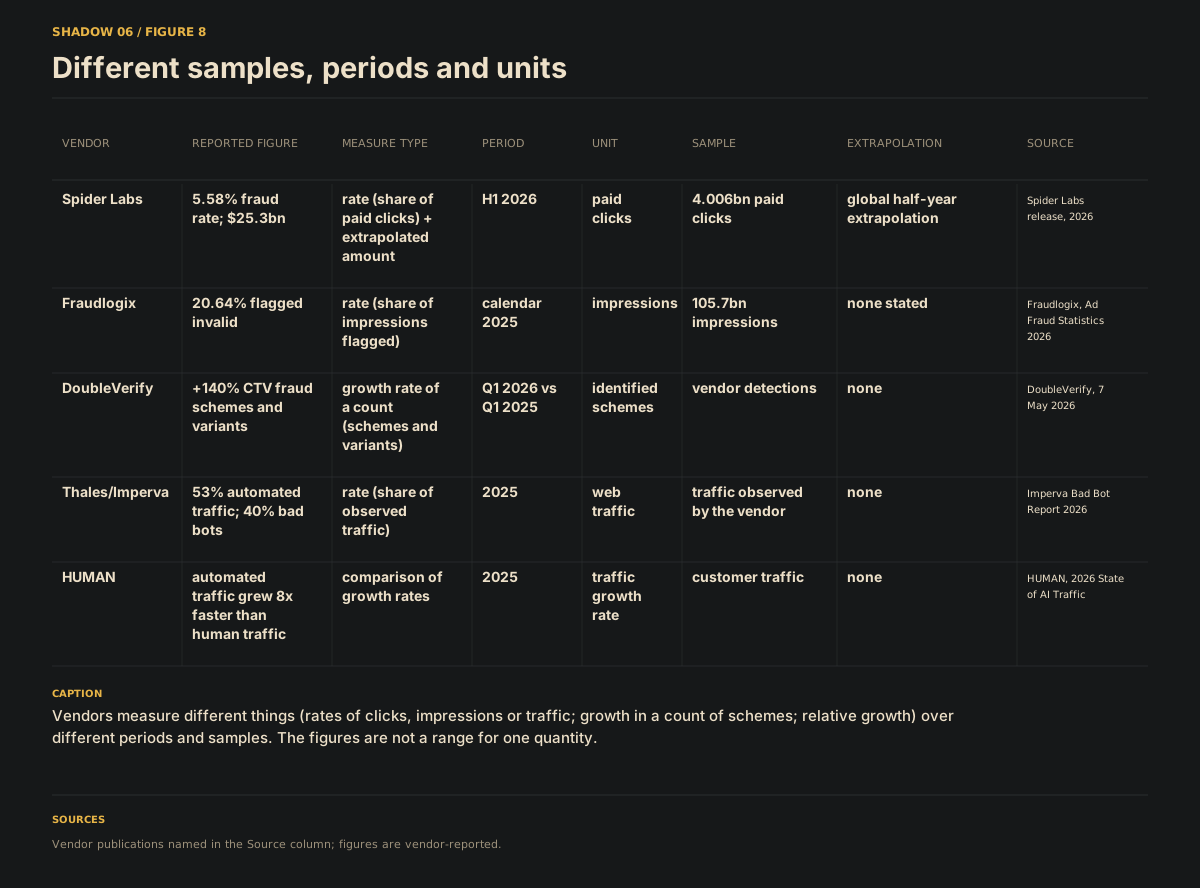
Each row is one company's headline figure. Read the measure type, unit, period and sample before the figure itself. Some figures are rates (a share of clicks, impressions or traffic), one is the growth of a count of schemes, and one compares growth rates. Rates, counts and growth rates measure different things, so they cannot be added, averaged or read as a range.
Sources: 7, 11, 72, 74, 75, 78, 79, 82, 83, 84, 85, 86, 87, 88.
Chapter 06 · Assisted scores, unaided skills
Help now. What remains later?
In a field experiment with nearly 1,000 secondary-school mathematics students in Turkey, unrestricted access to an AI assistant raised practice scores by 48% compared with a group without it. When the assistant was removed for the exam, the same students scored 17% lower than that group. A version built to give hints rather than answers raised practice scores by 127%, and the authors report that the exam loss was largely mitigated.12,13 A separate randomised study of 117 university students found that essays improved most with AI help, but no significant difference between groups in knowledge gained or transferred.14
Use is widespread among the students surveyed. HEPI's survey of 1,054 full-time UK undergraduates, conducted in December 2025, found that 95% use AI in some form and 94% use generative AI in assessed work. Including AI-generated text directly in assessed work was less common, at 12%, but has risen from 3% in 2024.91
Official announcements describe AI education in UAE public schools from kindergarten to Grade 12 from the 2025–26 academic year, and responsible-use measures at federal and emirate level. This section reports the measures described in those announcements; it does not evaluate implementation or educational outcomes.95
- Abu Dhabi. ADEK describes guardrails "designed to prevent overreliance on AI and protect students' cognitive agency" in more than 170 private schools.96
- Sharjah. WAM reported on 14 October 2026 that the Sharjah Private Education Authority had launched an ethical framework covering human oversight, students' original work, disclosure of AI use where appropriate, and verification of AI output.97
- Ras Al Khaimah. In an August 2025 statement reported by Khaleej Times, the Department of Knowledge named teacher training in responsible use as its first priority.98
- Dubai. In statements reported on 1 October 2026, KHDA said it was preparing a framework on when AI strengthens learning.99
- Ministry of Education. Gulf News (February 2026) and Education Middle East report that the Ministry's 2026 classroom guide allows generative AI only under teacher supervision, restricts it for pupils under 13 or below Year 7, and excludes it from formal examinations. We did not locate the guide itself.100
These are announced measures and stated objectives.
Swipe inside a figure to view more →
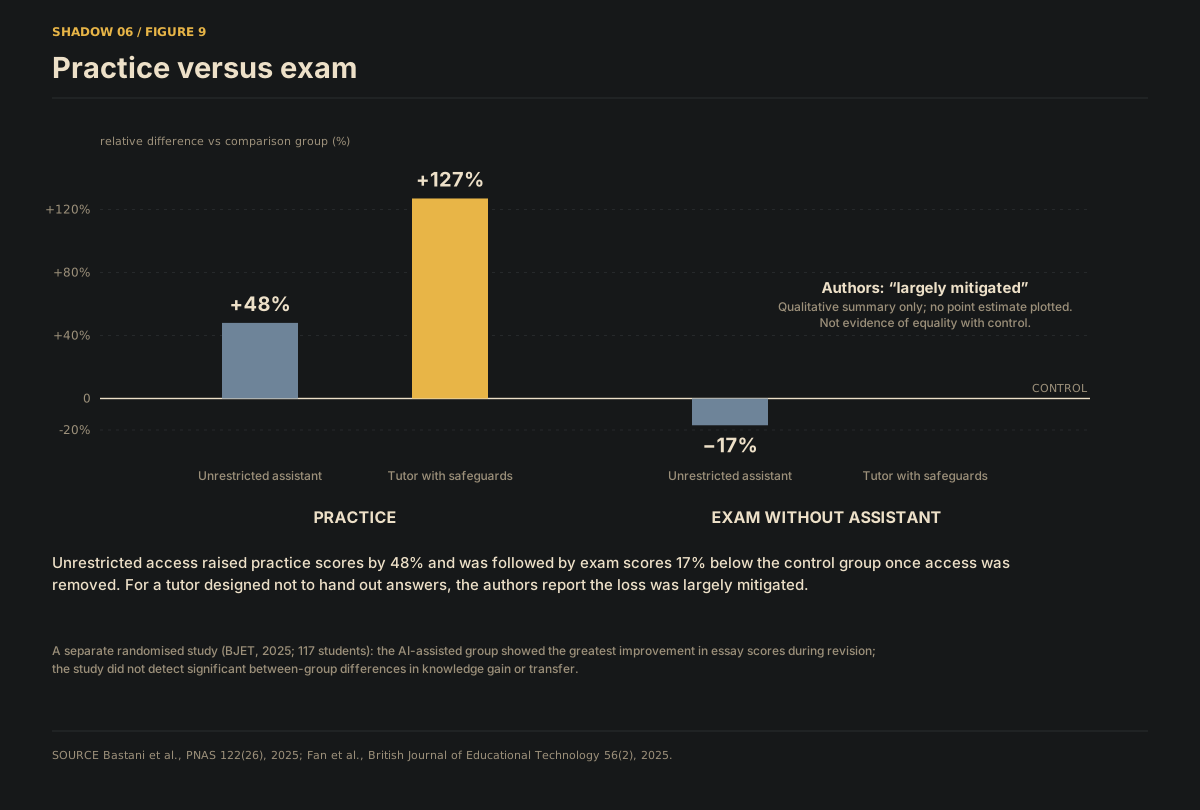
The bars show how much higher or lower each group scored than a comparison group without AI. The left pair covers practice sessions with AI; the right pair covers the exam taken without it. For the hint-based tutor, the exam result is given only as the authors describe it; no point estimate is plotted, and the label is not evidence of equality with the comparison group.
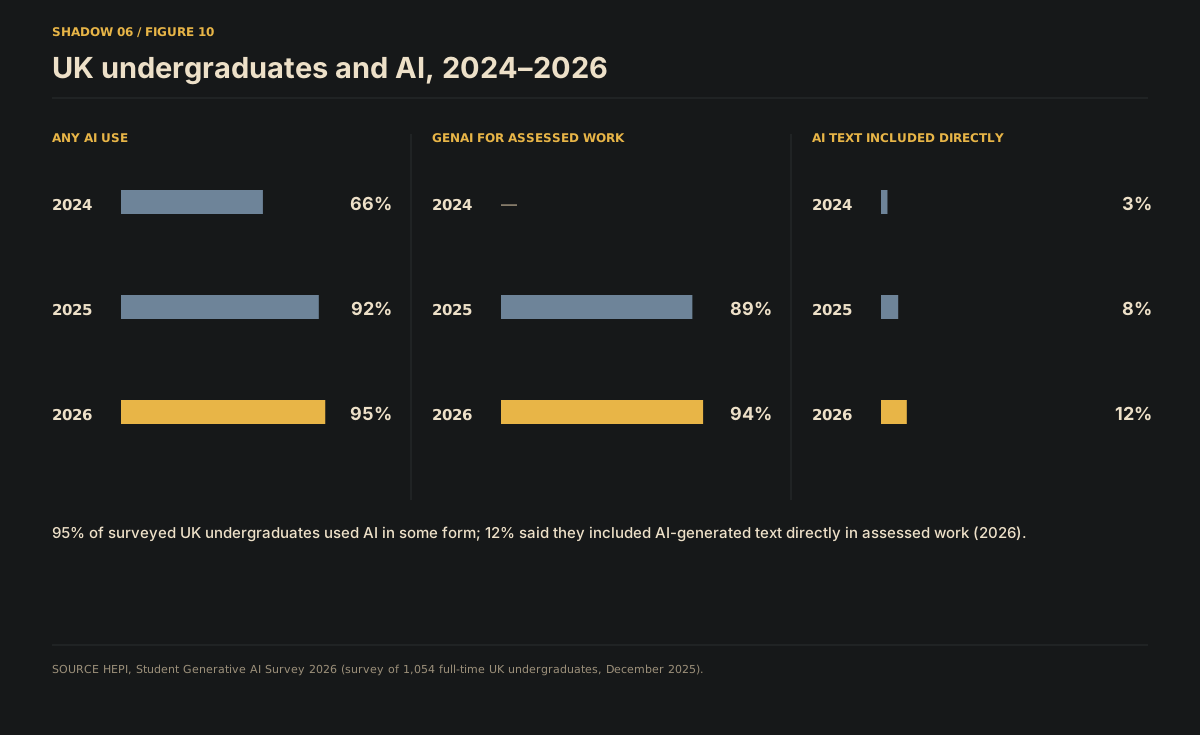
Each panel is one survey question, asked in 2024, 2025 and 2026 of full-time UK undergraduates. The first shows any use of AI, the second its use in assessed work, the third including AI-generated text directly in assessed work. No 2024 value is shown for assessed work.
Sources: 91
Chapter 07
What is not established.
This chapter sets out what the evidence does not support, so that the findings are not read as stronger than they are. The evidence does not show:
- that AI-written web pages are making current AI models worse;
- that fake engagement trains advertising systems to buy more of itself;
- that any conference runs an automatic cycle of AI-written papers, AI-written reviews and detector decisions;
- the total active population of the agent network, or the proportion operating autonomously. One study recorded 6,159 posting or commenting accounts within its specified early window;39
- a common share of synthetic content, or a single pattern of cost-shifting, across sectors.
Several working hypotheses were dropped or narrowed during checking. This review is not an exhaustive statement of AI-content obligations in the UAE, Saudi Arabia, Qatar, Bahrain or Oman; it records the instruments we identified and the limits of the source retrieval undertaken for this issue. Official texts from several other countries were found but could not be verified in enough detail, for reasons of language or access.57
Method
How this was checked.
Every claim rests on a logged source, graded by type:
- original documents;
- organisations' own reports and policies, which we always attribute;
- claims reported by news outlets whose original we could not find, which we name as such;
- documents found but not verified in detail;
- claims we could not establish.
Company figures are presented as what the company reports. Reports that rely on the same detection tool are not counted as independent confirmation of one another.
This issue was prepared with AI assistance. Because AI providers appear in it, material about each provider was checked by a model from a different provider. No provider is presented as an example of good practice, and facts about individual providers appear only in Figure F6.
The record closes on 18 October 2026, 23:59 (UTC+4). Later documents are not absorbed into this edition.
Before verification began, we recorded in writing how each possible result would change the text. Interpretation Lock SHA-256: f4915f763484ba8ddbe6ee2fa95aec913992a772d8b79fb0114719855177a310. Amendment A1: 040ff0b0dca790d555702ca9043b291c410cff7d51c1a5d10ec8dbd08c006a22. The sealed documents are kept in the project archive; their fingerprints allow any later release to be checked against them.
- Full report: Noise Floor (PDF, 37 pages).
- Figure data: one CSV file per figure — F1, F2, F3, F4, F5, F6, F7, F8, F9, F10.
Corrections: info@foresightflow.org
Sources
References.
Numbers in the text link to these entries. They follow the numbering of the PDF report. Where an entry has no link, the source was identified but no stable public URL was recorded.
- Pew Research Center (2026, 20 August). How much of the internet is written with AI? Data Labs, and accompanying methodology. https://www.pewresearch.org/data-labs/2026/08/20/how-much-of-the-internet-is-written-with-ai/
- Turnitin. AI writing detection in the new, enhanced Similarity Report (guide). https://guides.turnitin.com/hc/en-us/articles/22774058814093
- University of Waterloo (2025). Waterloo discontinuing the use of AI detection tool Turnitin.com: September 2025. https://uwaterloo.ca/associate-vice-president-academic/news/waterloo-discontinuing-use-ai-detection-tool-turnitincom
- Curtin University (2025). Update on Turnitin AI detection tool (AI writing detection disabled from 1 January 2026). https://www.curtin.edu.au/news/oasis-news/update-on-turnitin-ai-detection-tool/
- University of the Free State (2026, May). UFS shifts academic integrity approach in AI era (Turnitin AI detection discontinued from 1 July 2026). https://www.ufs.ac.za/templates/news-archive/campus-news/2026/may/ufs-shifts-academic-integrity-approach-in-ai-era
- Matter of Newby v Adelphi University, 2026 NY Slip Op 26021 (Sup. Ct. Nassau County, 28 January 2026). https://www.nycourts.gov/reporter/3dseries/2026/2026_26021.htm
- NeurIPS 2026 Program Chairs (2026, 2 June). AI-generated papers in the NeurIPS 2026 Position Paper Track. NeurIPS blog. https://blog.neurips.cc/2026/06/02/ai-generated-papers-in-the-neurips-2026-position-paper-track/
- Liang, W., et al. (2024). Monitoring AI-modified content at scale: a case study on the impact of ChatGPT on AI conference peer reviews. Proceedings of ICML 2024, PMLR 235. https://proceedings.mlr.press/v235/liang24b.html
- OpenAI (2026, 5 October). Our approach to EU text provenance rules. https://openai.com/index/eu-text-provenance/
- Dathathri, S., et al. (2024). Scalable watermarking for identifying large language model outputs. Nature, 634, 818–823. https://doi.org/10.1038/s41586-024-08025-4; reference code: https://github.com/google-deepmind/synthid-text
- arXiv (2026, 1 October). Updated rate limit policy. arXiv blog. https://blog.arxiv.org/2026/10/01/updated-rate-limit-policy/
- Bastani, H., Bastani, O., Sungu, A., Ge, H., Kabakcı, Ö., & Mariman, R. (2025). Generative AI without guardrails can harm learning: evidence from high school mathematics. PNAS, 122(26), e2422633122. https://doi.org/10.1073/pnas.2422633122
- Knowledge at Wharton. Without guardrails, generative AI can harm education. https://knowledge.wharton.upenn.edu/article/without-guardrails-generative-ai-can-harm-education/
- Fan, Y., et al. (2025). Beware of metacognitive laziness: effects of generative artificial intelligence on learning motivation, processes, and performance. British Journal of Educational Technology, 56(2), 489–530. https://doi.org/10.1111/bjet.13544
- Deezer (2026, 21 July). Newsroom release on fully AI-generated music uploads. https://newsroom-deezer.com/2026/07/ai-music-exceeds-50-percent-daily-uploads-deezer/
- Deezer (2026, April). Newsroom release on AI-generated tracks as a share of new uploads. https://newsroom-deezer.com/2026/04/ai-generated-tracks-represent-44-of-new-uploaded-music/
- Spotify (2025, 25 September). Spotify strengthens AI protections. Newsroom. https://newsroom.spotify.com/2025-09-25/spotify-strengthens-ai-protections/
- Bandcamp (2026, 13 January). Keeping Bandcamp human. https://blog.bandcamp.com/2026/01/13/keeping-bandcamp-human/
- Meta (2025, 25 September; 6 November). Introducing Vibes; Bringing Vibes to Europe. Meta Newsroom. https://about.fb.com/news/2025/09/introducing-vibes-ai-videos/
- Bloomberg; TechCrunch; Axios (2025, 30 September). Reports on the release of the Sora social video app. https://www.bloomberg.com/news/articles/2025-09-30/openai-releases-social-app-for-sharing-ai-videos-from-sora
- YouTube Help (2025, July). Channel monetisation policies: inauthentic content. https://support.google.com/youtube/answer/1311392
- Kapwing (2025). AI slop report: the global rise of low-quality AI videos. https://www.kapwing.com/blog/ai-slop-report-the-global-rise-of-low-quality-ai-videos/
- NewsGuard. AI Tracking Center: AI content farm news and information sites (update dated 23 June 2026). https://www.newsguardtech.com/special-reports/ai-tracking-center/
- Pangram Labs (2025, 18 November). Pangram predicts 21% of ICLR reviews are AI-generated. https://www.pangram.com/blog/pangram-predicts-21-of-iclr-reviews-are-ai-generated
- WAN-IFRA (2026, 10 July). He's found 15,000 fake AI news sites: here's what you need to know (interview with Jean-Marc Manach). https://wan-ifra.org/2026/07/hes-found-15000-fake-ai-news-sites-heres-what-you-need-to-know/
- The Lancet (2026). Audit of fabricated references in published medical research, first seven weeks of 2026 (Columbia University). PII S0140-6736(26)00603-3. https://doi.org/10.1016/S0140-6736(26)00603-3
- Baack, S. (2024, 6 February). Training data for the price of a sandwich: Common Crawl's impact on generative AI. Mozilla Foundation. https://www.mozillafoundation.org/en/blog/Mozilla-Report-How-Common-Crawl-Data-Infrastructure-Shaped-the-Battle-Royale-over-Generative-AI/
- Common Crawl (2025). Submission to the UK's copyright and AI consultation. https://commoncrawl.org/blog/submission-to-the-uks-copyright-and-ai-consultation
- Shumailov, I., et al. (2024). AI models collapse when trained on recursively generated data. Nature, 631, 755–759. https://doi.org/10.1038/s41586-024-07566-y
- Gerstgrasser, M., et al. (2024). Is model collapse inevitable? Breaking the curse of recursion by accumulating real and synthetic data. arXiv:2404.01413. https://arxiv.org/abs/2404.01413
- Hans, A., et al. (2024). Spotting LLMs with Binoculars: zero-shot detection of machine-generated text. Proceedings of ICML 2024, PMLR 235. https://proceedings.mlr.press/v235/hans24a.html
- Graphite (2026). AI now writes as many online articles as humans do. https://graphite.io/five-percent/research/ai-now-writes-as-many-online-articles-as-humans-do
- Originality.ai (2026, August). Dead internet tracker. https://originality.ai/blog/dead-internet-tracker-august
- Emarat Al Youm (2026, 4 September). Report on the first week of the 2026–27 school year and AI use in UAE schools (Arabic). https://www.emaratalyoum.com/local-section/education/2026-09-04-1.2079608
- Liang, W., Yuksekgonul, M., Mao, Y., Wu, E., & Zou, J. (2023). GPT detectors are biased against non-native English writers. Patterns, 4(7). arXiv:2304.02819. https://arxiv.org/abs/2304.02819
- Willison, S. (2026, 30 January). Moltbook. https://simonwillison.net/2026/Jan/30/moltbook/
- Wiz Research (2026, 2 February). Exposed Moltbook database reveals millions of API keys. https://www.wiz.io/blog/exposed-moltbook-database-reveals-millions-of-api-keys
- Reuters (2026, February). Interview with Ami Luttwak, Wiz, on the Moltbook exposure (as republished by Calcalist).
- Holtz, D. (2026). The anatomy of the Moltbook social graph. arXiv:2602.10131. https://arxiv.org/abs/2602.10131
- Claude Help Centre. How Claude marks AI-generated content (retrieved October 2026). https://support.claude.com/en/articles/16266773-how-claude-marks-ai-generated-content
- OpenAI (2026, 19 May; update 31 July). Advancing content provenance. https://openai.com/index/advancing-content-provenance/
- C2PA. Frequently asked questions. https://c2pa.org/faqs/
- Saberi, M., et al. (2023). Robustness of AI-image detectors: fundamental limits and practical attacks. arXiv:2310.00076. https://arxiv.org/abs/2310.00076
- CVPR 2026. Visual paraphrase attack on image watermarks (conference poster 39859). https://cvpr.thecvf.com/virtual/2026/poster/39859
- Kazempourradi, S., Mojtahedi, R., & Mohseni, B. (2026). Watermarks and fingerprints as soft bindings for content provenance: an open-licence benchmark for images, audio and video. arXiv:2610.04151 (authors affiliated with Original Pictures Technologies, Inc.). https://arxiv.org/abs/2610.04151
- House of Commons Library (2026, 20 January). AI content labelling (CBP-10467). https://commonslibrary.parliament.uk/research-briefings/cbp-10467/
- Wittenberg, C., Epstein, Z., Péloquin-Skulski, G., Berinsky, A. J., & Rand, D. G. (2025). Labeling AI-generated media online. PNAS Nexus, 4(6), pgaf170. https://doi.org/10.1093/pnasnexus/pgaf170
- National AI Centre, Department of Industry, Science and Resources (2025, November). Being clear about AI-generated content: a guide for business. https://www.industry.gov.au/publications/being-clear-about-ai-generated-content
- Regulation (EU) 2024/1689 (Artificial Intelligence Act), Articles 50, 99 and 113, consolidated text as amended. AI Act Service Desk. https://ai-act-service-desk.ec.europa.eu/en/ai-act/article-50
- California AB 853 (2025), Chapter 674, Statutes of 2025. https://legiscan.com/CA/text/AB853/2025
- European Commission (2026, 10 June). Commission publishes Code of Practice on marking and labelling of AI-generated content. https://digital-strategy.ec.europa.eu/en/news/commission-publishes-code-practice-marking-and-labelling-ai-generated-content
- Regulation (EU) 2026/1744 of 8 July 2026 (Digital Omnibus). Official Journal of the European Union. https://eur-lex.europa.eu/eli/reg/2026/1744/oj/eng
- California SB 1000 (2026), Chapter 861, Statutes of 2026, approved 30 September 2026. https://legiscan.com/CA/text/SB1000/2025
- California AB 2713 (2026). https://legiscan.com/CA/text/AB2713/2025
- Ministry of Electronics and Information Technology, India (2026). Information Technology (Intermediary Guidelines and Digital Media Ethics Code) Amendment Rules, 2026, and FAQs on synthetically generated information. https://www.meity.gov.in/
- Ministry of Science and ICT, Republic of Korea (2026). AI Basic Act commencement and guidance on marking of AI outputs. https://www.msit.go.kr/eng/
- Official instruments located but not cleared for detailed description: Cyberspace Administration of China (cac.gov.cn); Diet of Japan (sangiin.go.jp); Chamber of Deputies of Brazil (camara.leg.br); Superior Electoral Court of Brazil (tse.jus.br); SDAIA, Saudi Arabia (sdaia.gov.sa); ai.gov.eg (Egypt); publication.pravo.gov.ru (Russia); adilet.zan.kz (Kazakhstan); INE, Mexico (ine.mx); Public Prosecutor's Office, Argentina (fiscales.gob.ar); MinTIC, Colombia (mintic.gov.co); HACA, Morocco (haca.ma).
- eSafety Commissioner (2024). Designated Internet Services Standard: registration fact sheet. https://www.esafety.gov.au/sites/default/files/2024-06/Fact-sheet-registration-DIS-Standard.pdf
- WAM (2025, 25 September). UAE Media Council: using AI to depict national symbols without prior approval violates media content standards. https://www.wam.ae/en/article/blvxe9y-uae-media-council-warns-against-misuse-harmful
- WAM (2026, 22 August). ICCMD unveils advanced digital monitoring system, launches International Charter for Media Integrity. https://www.wam.ae/en/article/c1v24vf-iccmd-unveils-advanced-digital-monitoring-system
- Ministry of Communications and Information Technology, Qatar. Guidelines for secure adoption and usage of AI (ethical guidelines). https://www.mcit.gov.qa/
- Information & eGovernment Authority, Bahrain (2025, July). General Policy for the Use of Artificial Intelligence. https://www.iga.gov.bh/
- Ministry of Transport, Communications and Information Technology, Oman (2025, 1 April). General Policy for the Safe and Ethical Use of AI Systems. https://www.mtcit.gov.om/
- Government of Viet Nam (2026). Law on Artificial Intelligence No. 134/2025/QH15 (English text). https://en.baochinhphu.vn/viet-nams-law-on-artificial-intelligence-111260715113551787.htm
- Elections Department Singapore. Candidates' online election campaigning. https://www.eld.gov.sg/candidate_parliamentary_campaign_online.html
- ANTARA (2025, 27 June). Indonesian govt, CSOs to develop tool to detect deepfakes. https://en.antaranews.com/news/362473/indonesian-govt-csos-to-develop-tool-to-detect-deepfakes
- Ministry of Science, Technology and Innovation, Malaysia (2024). The National Guidelines on AI Governance and Ethics. https://mastic.mosti.gov.my/storage/2024/09/THE-NATIONAL-GUIDELINES-ON-AI-GOVERNANCE-ETHICS.pdf
- Media Council of Kenya. Media guide on the use of artificial intelligence in Kenya. https://mediacouncil.or.ke/
- National Council of Television and Radio Broadcasting of Ukraine. How to responsibly use artificial intelligence: guidelines developed for media. https://webportal.nrada.gov.ua/en/how-to-responsibly-use-artificial-intelligence-guidelines-developed-for-media/
- NCC-CSIRT, Nigerian Communications Commission (2026). Advisory 2026-026: AI-driven social engineering and deepfake threats. https://csirt.ncc.gov.ng/
- arXiv (2025, 31 October; 2026, 21 January). Policy updates on review and position papers in computer science, and on endorsement. arXiv blog. https://blog.arxiv.org/2026/01/21/attention-authors-updated-endorsement-policy/
- Research Information (2026). arXiv imposes one-year ban for unchecked AI-generated content. https://www.researchinformation.info/news/arxiv-imposes-one-year-ban-for-unchecked-ai-generated-content/
- CVPR, ICCV, AAAI, WSDM and KDD (2025–2026). Author guidelines and submission policies for the respective conference editions and tracks.
- ICLR (2025, 15 April). Leveraging LLM feedback to enhance review quality. ICLR blog; accompanying paper arXiv:2504.09737. https://blog.iclr.cc/2025/04/15/leveraging-llm-feedback-to-enhance-review-quality/
- Robert Half (2026, 14 September). Robert Half research reveals AI-generated applications are slowing hiring (UK). https://pressreleases.responsesource.com/news/107598/
- Robert Half (2026, 10 March). Robert Half survey: 67% of HR leaders report AI-generated applications are slowing hiring (US). https://press.roberthalf.com/2026-03-10-Robert-Half-survey-67-of-HR-leaders-report-AI-generated-applications-are-slowing-hiring
- Robert Walters (2026). Middle East employer survey on AI-assisted job applications (company post on LinkedIn; link is to coverage by MIT Sloan Management Review Middle East). https://www.mitsloanme.com/article/42-of-middle-east-employers-are-drowning-in-ai-generated-job-applications-survey-reveals/
- Amazon Kindle Direct Publishing. Content guidelines; title creation limits (help pages retrieved October 2026). https://kdp.amazon.com/en_US/help/topic/G200672390
- Federal Trade Commission (2024, August). Final rule banning fake reviews and testimonials (16 CFR Part 465); Consumer Reviews and Testimonials Rule: questions and answers; cases and proceedings (2026). https://www.ftc.gov/business-guidance/resources/consumer-reviews-testimonials-rule-questions-answers
- Federal Trade Commission (2025, 22 December). FTC reopens and sets aside Rytr final order. https://www.ftc.gov/news-events/news/press-releases/2025/12/ftc-reopens-sets-aside-rytr-final-order-response-trump-administrations-ai-action-plan
- Pangram Labs (2026, May). AI-generated Amazon reviews. https://www.pangram.com/blog/ai-amazon-reviews
- Thales / Imperva (2026). Bad Bot Report 2026. https://www.imperva.com/blog/bad-bot-report-2026-bots-agentic-age/
- HUMAN Security (2026). 2026 State of AI Traffic and Cyberthreat Benchmarks. https://www.humansecurity.com/learn/resources/2026-state-of-ai-traffic-cyberthreat-benchmarks/
- Spider Labs (2026, 2 September). Spider AF report reveals $25.3B global first-half ad fraud losses (press release). https://www.newswire.com/news/spider-af-report-reveals-25-3b-global-first-half-ad-fraud-losses-22855835
- Fraudlogix (2026). Ad fraud statistics 2026. https://www.fraudlogix.com/stats/ad-fraud-statistics-2026/
- DoubleVerify (2026, 7 May). Global study: fuelled by AI, CTV fraud schemes surge 140% globally. https://doubleverify.com/company/newsroom/global-study-ctv-fraud-schemes-surge-140-globally
- Immorlica, N., Jain, K., Mahdian, M., & Talwar, K. (2005). Click fraud resistant methods for learning click-through rates. WINE 2005, LNCS 3828, 34–45. https://doi.org/10.1007/11600930_5
- SIGIR 2026. Paper on post-click conversion-rate prediction with noisy conversion labels. https://doi.org/10.1145/3805712.3809570
- OECD (2026). OECD Digital Education Outlook 2026. OECD Publishing.
- Pew Research Center (2026, 24 February). How teens use and view AI. https://www.pewresearch.org/internet/2026/02/24/how-teens-use-and-view-ai/
- Higher Education Policy Institute (2026). Student Generative AI Survey 2026 (HEPI Report 199). https://www.hepi.ac.uk/wp-content/uploads/2026/03/HEPI-Report-199-Gen-AI-Survey-2026.pdf
- Lee, H.-P., et al. (2025). The impact of generative AI on critical thinking: self-reported reductions in cognitive effort and confidence effects from a survey of knowledge workers. Proceedings of CHI 2025. https://doi.org/10.1145/3706598.3713778
- Kosmyna, N., et al. (2025). Your brain on ChatGPT: accumulation of cognitive debt when using an AI assistant for essay writing task. arXiv:2506.08872 (preprint). https://arxiv.org/abs/2506.08872
- OECD (2024, December). Do adults have the skills they need to thrive in a changing world? Survey of Adult Skills 2023. https://www.oecd.org/en/publications/do-adults-have-the-skills-they-need-to-thrive-in-a-changing-world_b263dc5d-en.html
- Ministry of Education, UAE (2025). Ministry of Education introduces AI curriculum in public schools starting from the 2025–2026 academic year (press release; WAM). https://www.wam.ae/en/article/bji6z2n-ministry-education-introduces-curriculum-public
- Abu Dhabi Department of Education and Knowledge (2026, 17–18 September). ADEK advances AI Literacy Initiative across 170 private schools. https://www.adek.gov.ae/Media-Centre/News/ADEK-Advances-AI-Literacy-Initiative-across-170-Private-Schools
- WAM (2026, 14 October). Sharjah Private Education Authority launches ethical framework for AI use in schools. https://www.wam.ae/en/article/c2qm385-sharjah-private-education-authority-launches
- Khaleej Times (2025, August). AI in RAK schools: teachers, curriculum (statements by the Ras Al Khaimah Department of Knowledge). https://www.khaleejtimes.com/uae/ai-in-rak-schools-teachers-curriculum
- Khaleej Times; The National (2026, 1 October). Statements by KHDA on a framework for AI and technology use in Dubai schools. https://www.khaleejtimes.com/uae/education/khda-set-clear-direction-ai-technology-use-dubai-schools
- Gulf News (2026, February). UAE sets strict new rules on generative AI in schools, banning use for under-13s; Education Middle East (2026). UAE issues new AI guidelines for schools. https://gulfnews.com/uae/education/uae-sets-strict-new-rules-on-generative-ai-in-schools-banning-use-for-under-13s-1.500443163
- Rest of World (2026, 13 October). Report on AI education in UAE schools. https://restofworld.org/2026/uae-mandates-k12-ai-education-schools/
- Ministerio de Ciencia, Tecnología, Conocimiento e Innovación, Chile. Account of the AI bill's legislative progress. https://www.minciencia.gob.cl/
- WAM (2025, 18 December). UAE Government issues Federal Decree-Law establishing, organising National Media Authority; National Media Authority, FAQ (Federal Decree-Law No. 11 of 2025). https://www.wam.ae/en/article/bn9xsue-uae-government-issues-federal-decree-law
- Khaleej Times (2026, 30 September). UAE National Media Authority warns against AI images of national symbols; Gulf News (2026, 29 September). UAE warns against AI-generated images of national symbols, public figures. The Authority's post itself was not retrieved. https://www.khaleejtimes.com/uae/uae-national-media-authority-warns-against-ai-images-of-national-symbols-rules
- European Commission (2026, 20 July). Guidelines on transparency obligations for providers and deployers of AI systems. https://digital-strategy.ec.europa.eu/en/library/guidelines-transparency-obligations-providers-and-deployers-ai-systems
Disclosure
Disclosure and research notice.
Research notice and methodology disclaimer
- Scope. This study is conducted in a personal capacity by contributors to the Foresight Future Institute. It is independent editorial research into AI-generated content, its marking and its verification. It does not reflect the views of any employer or official body.
- What "not located" means. A statement that a document, rule or feature was not located means that it was not retrieved in the searches made for this issue, up to the close of the record. It is not a statement that it does not exist, and not a statement about the internal workings of any body.
- No ranking, no evaluation. The report does not rank countries, providers, institutions or platforms, and does not evaluate their performance. It does not evaluate the implementation or outcomes of the measures it describes.
- Legal and policy summaries. Summaries of laws, guidance and policies are limited to the instruments and dates specified. They are not an exhaustive statement of applicable law, and not an assessment of anyone's compliance.
- Reports, classifications and findings. Figures and classifications published by organisations are reported as theirs and attributed in the sentence. A detector score, a vendor classification or a platform's own label is not a finding of misconduct. Decisions of courts and official bodies are identified as such and reported within their stated scope.
- Named bodies. Authorities, institutions and companies are named only where a public document concerns them, and each statement reports what that document says. Naming does not imply endorsement or criticism.
- AI assistance. The text was prepared with AI assistance and checked as described in the Method. Errors are possible. Every factual statement carries a numbered reference, so that a reader can check it.
- Not advice, no liability. Nothing here is legal, financial or professional advice. To the extent permitted by applicable law, the authors and the Foresight Future Institute accept no liability for decisions that third parties take on the basis of this report.
- Sources and currency. Links lead to documents of third parties, which can change or be withdrawn. The record closes on 18 October 2026, 23:59 (UTC+4). Later documents are not absorbed into this edition.
- Corrections. Any body or reader may send a verifiable document to info@foresightflow.org. Corrections are dated and published, and the earlier text stays visible.
Not an allegation against any named person or body. Nothing here constitutes legal advice. Statements of fact are limited to matters recorded in the public sources cited and are reports of what those sources state.